There is a version of this article that begins with the history — with Ferry Porsche and the 356, with the 901 that became the 911, with thirty years of iterative refinement that culminated in the final expression of an idea. That version exists. This is not it.
This is the version for the man who has decided he wants a 993 and needs to know how to buy one without getting taken. So let's start there.
The Porsche 993 was built between 1994 and 1998. It was the last 911 to use air-cooling — the technology that had defined the car since its introduction in 1963. When Porsche switched to water-cooling with the 996 in 1999, the 993 became something it hadn't been while in production: irreplaceable. Values have reflected that ever since, and they show no sign of reversing.
A clean Carrera today trades between $85,000 and $145,000 depending on specification, mileage, and condition. Turbos start at $175,000 and climb steeply from there. The right example at the right price still exists — but it requires patience, preparation, and the willingness to walk away from a car that isn't right.
"The 993 is not the best 911 ever made by every measurable standard. It is the best 911 ever made by every standard that actually matters."
Understanding the 993 Family
Before you start looking, you need to know what you're looking for. The 993 isn't a single car — it's a family of variants that share a platform and engine architecture but differ significantly in character, capability, and cost.
Carrera 2 — The One to Buy First
The Carrera 2 is the rear-wheel-drive, naturally aspirated version. It uses the 3.6-litre Varioram flat-six producing 272 horsepower, paired either with the six-speed Getrag G50 manual or the four-speed Tiptronic automatic. The manual is the correct choice. Full stop.
The C2 is the purest version of the 993 — the one with the most direct steering, the most feedback, and the most honest relationship between driver and machine. It is also the most available, the most straightforward to maintain, and the most sensible first Porsche for a buyer entering the air-cooled world.
Carrera 4 and Carrera 4S
The C4 adds all-wheel drive at a modest premium over the C2. It's a heavier car with slightly diluted feedback — still magnificent, but not the first choice for a driver-focused buyer. The C4S is more interesting: it uses the wide-body bodywork from the Turbo — flared rear arches, a more aggressive stance — but retains the naturally aspirated engine. If you want the Turbo look without the Turbo complexity and cost, the C4S makes a compelling case.
Targa and Cabriolet
The Targa uses a unique panoramic rear glass arrangement with a removable roof panel — a distinctive and attractive package. It adds complexity and some structural flex compared to the coupe. The Cabriolet is the open-air version, suited to warm climates and less focused driving. Both are excellent 993s — but neither is where you start if you're buying your first one.
The Turbo
The 993 Turbo is a different category of car. Twin turbocharged, all-wheel drive, 408 horsepower in standard specification, and one of the most dramatic-looking 911s ever produced with its wide-body stance and fixed whale-tail spoiler. It is a genuine supercar from 1995 and drives like one. It is also a different ownership proposition — more maintenance, more cost, more complexity. Buy the Carrera first. Then consider the Turbo with the benefit of experience.
Start with the Carrera 2 coupe, manual gearbox. It is the most honest version of the car, the most available at sensible prices, and the one that will teach you what the 993 actually is. Everything else in the family — Turbo, GT2, Targa — follows once you understand the foundation.
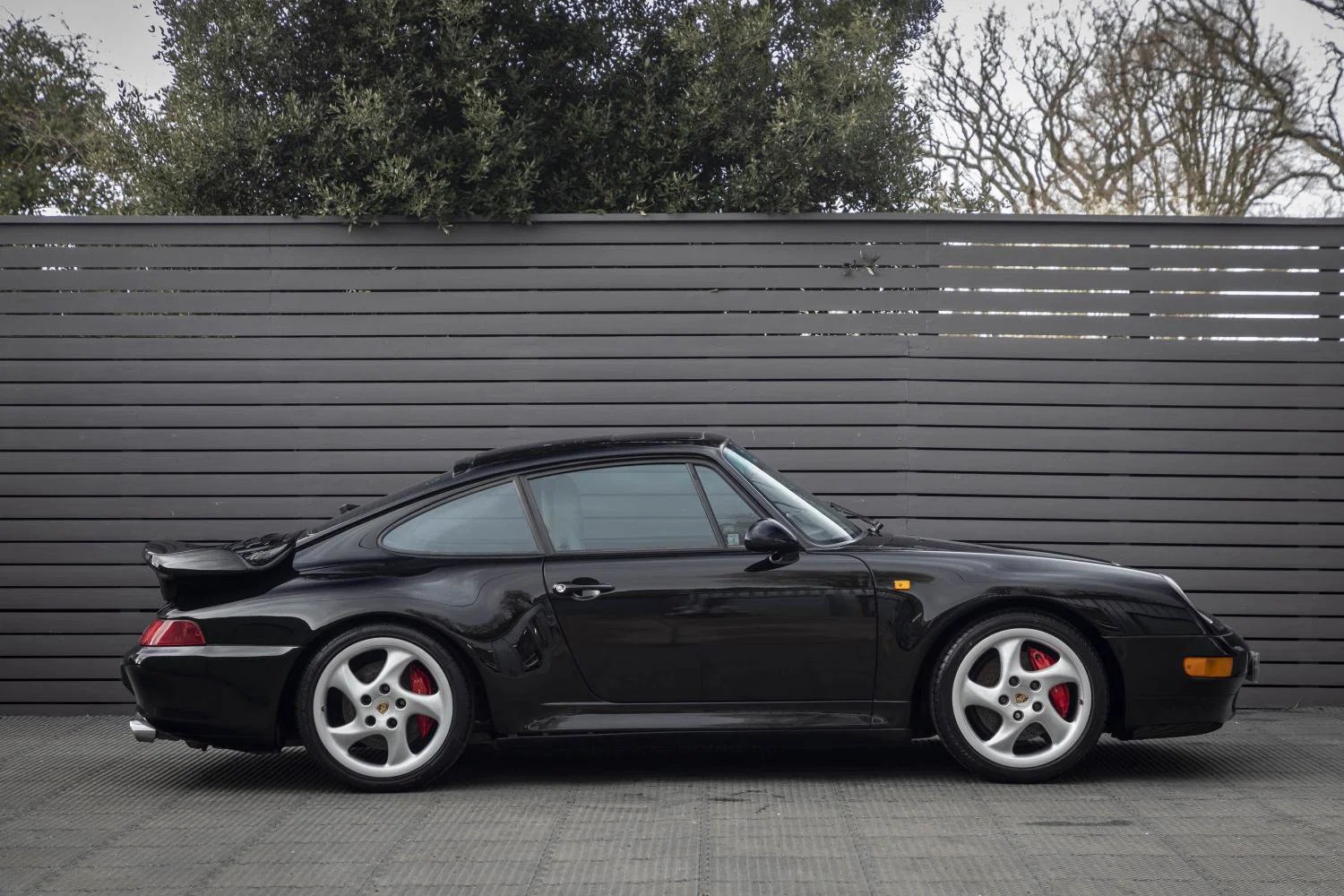
The 993 Turbo. Wide-body arches, fixed rear spoiler, red brake calipers. The most dramatic 911 of the air-cooled era — and among the most collectible Porsches ever built.
What to Inspect — The Detailed Checklist
Every 993 on the market today is between 27 and 31 years old. That is not a reason to avoid one — these are extraordinarily well-built machines that respond well to proper maintenance. But age means history, and history means you need to look carefully at what that history contains.
The Engine
The air-cooled flat-six is the heart of everything. Here's what matters:
- Oil consumption — all 993s consume some oil. This is normal and expected. What you're looking for is the rate: more than one litre per 1,000 miles indicates wear that needs investigation before purchase. Ask the seller how often they add oil and between which service intervals.
- Timing chain tensioners — this is the most cited wear item on the 993 engine. The tensioners can wear over time, leading to chain rattle on cold starts. Ask to see service records that confirm replacement. If they haven't been done, price it into your offer — it's not a deal-breaker but it needs to happen.
- Oil leaks — look carefully around the cam covers, the base of the engine, and the area around the rear main seal. Some seepage is common with age. Significant leaks are a negotiating point at minimum and a warning flag at worst.
- Cold start behaviour — the engine should fire quickly and idle smoothly within seconds. Any extended cranking, rough idle, or unusual smoke on startup needs to be explained.
- Cooling system — the 993 uses coolant for the front oil cooler, which is often misunderstood. Check the coolant reservoir condition and inspect the hoses carefully for cracks or deterioration.
The Transmission
The Getrag G50 six-speed manual is an excellent gearbox — precise, robust, and well-suited to the car. What to check:
- Run through all six gears carefully during the test drive. Listen for grinding on any ratio, particularly second and third which see the most use.
- The synchromesh on older gearboxes can wear — a slight resistance on a cold gearbox is normal. Grinding when warm is not.
- Check for any whine or noise in neutral with the clutch engaged, which can indicate bearing wear.
- The clutch pedal should be firm and progressive. A very light or very heavy clutch, or one that engages unusually high or low in the pedal travel, needs attention.
Body and Rust — The Most Critical Inspection
Rust is the issue that ends conversations. The 993's body, while well-built, has specific areas that are known to trap moisture and develop rust over three decades. These are non-negotiable inspection points:
- Battery tray area — located in the front luggage compartment. Battery acid leaks combined with trapped moisture make this a common rust location. Lift the carpet and look carefully.
- Front luggage compartment floor — the entire floor of the front boot should be inspected. Look for bubbling paint, soft spots, or any sign of repair.
- Rear quarter panels — particularly at the base where they meet the sills. This area traps road debris and moisture.
- Door sills — run your hand along the underside of both sills. Any roughness or softness indicates corrosion.
- Sunroof drains (if equipped) — blocked drains lead to water ingress into the cabin and subsequent rust. Check the carpet for any dampness.
Any structural rust is a reason to walk away, regardless of price. Rust repair on a 993 is expensive, difficult, and often incomplete. A car with rust in the battery tray or floor panels is not a project — it is a liability. There are enough clean cars on the market that you do not need to compromise on this.
Paint and Body Panels
Bring a paint thickness gauge or ask your inspector to use one. Original Porsche paint on unrepaired panels measures consistently — typically between 80 and 130 microns. Any panel reading significantly higher has been resprayed, which may indicate accident repair. This is not necessarily a dealbreaker, but it needs to be disclosed and explained.
Walk around the car and look at the panel gaps. They should be consistent, even, and parallel. Uneven gaps, particularly at the front or rear, suggest the car has been in an accident and may not have been properly realigned.
Interior
The 993 interior ages well but shows use. What to look for:
- Leather condition on the seats, steering wheel, and door cards — cracking and excessive wear is cosmetically acceptable but factors into value
- Dashboard — the 993 dash is prone to cracking with age and UV exposure. Replacement is expensive. Factor this into your offer on any car with a cracked dash.
- All electrical systems — windows, climate control, radio, sunroof, mirrors. Test everything. Electrical gremlins on a 30-year-old Porsche can be time-consuming and expensive to trace.
- Carpets — lift them where possible and check for moisture. Damp carpets indicate either a sunroof drain issue or a more significant water ingress problem.
Specifications at a Glance
| Production years | 1994–1998 |
| Engine | 3.6-litre air-cooled flat-six (Varioram) |
| Power — Carrera | 272 hp @ 6,100 rpm |
| Power — Turbo | 408 hp @ 5,750 rpm (twin-turbo) |
| Torque — Carrera | 243 lb-ft @ 5,000 rpm |
| Gearbox options | 6-speed Getrag G50 manual / 4-speed Tiptronic |
| 0–60 mph (Carrera manual) | 5.4 seconds |
| 0–60 mph (Turbo) | 4.3 seconds |
| Curb weight — Carrera 2 | 1,370 kg (3,020 lbs) |
| Curb weight — Turbo | 1,500 kg (3,307 lbs) |
| Market value — Carrera (2025) | $85,000–$145,000 |
| Market value — Turbo (2025) | $175,000–$280,000+ |
The Pre-Purchase Inspection
This is non-negotiable: every 993 you seriously consider buying must go through an independent pre-purchase inspection (PPI) from a Porsche specialist before money changes hands. Not a general mechanic. Not the selling dealer. An independent specialist who works on air-cooled Porsches regularly.
Budget $400–700 for a thorough PPI. In the context of an $85,000–$145,000 purchase, this is not a cost — it is insurance. A PPI has the potential to save you tens of thousands of dollars by identifying issues before you're committed, or to confirm that a car is what it appears to be and allow you to buy with genuine confidence.
A good PPI should include: compression test on all six cylinders, leak-down test, full oil analysis, undercarriage inspection on a lift, paint thickness readings on all panels, full electrical check, and a road test by the inspector. Ask for a written report with photographs. Any seller who refuses a PPI on a car they claim is solid is telling you something.
When a seller declines a pre-purchase inspection, the correct response is not to negotiate harder. It is to move on. There are enough good 993s on the market that you should never need to compromise on due diligence.
Where to Buy
The source of a 993 matters as much as the condition of the car itself. The safest purchases come from sellers with transparent history, documented service records, and accountability within the Porsche community.
Bring a Trailer
The gold standard for enthusiast car purchases. Every listing on BaT includes a full history, community vetting through the comments section, and a level of transparency that private sales and general auction houses rarely match. The community asks hard questions and sellers who can't answer them are exposed. Search the completed listings to understand what comparable cars have sold for — this is the most accurate real-time pricing data available.
PCA Classifieds
The Porsche Club of America classifieds are populated primarily by enthusiast owners — people who have maintained their cars properly and understand what they have. The community is self-policing and cars listed here are generally more honestly represented than in the general market.
Rennlist Classifieds
The largest dedicated Porsche forum. Deep community knowledge and peer accountability. A seller who misrepresents a car in the Rennlist community will hear about it. Search the forum history for any car you're seriously considering — if it's been discussed, that discussion is often illuminating.
Specialist Dealers
There are dealers who specialise specifically in air-cooled Porsches and have built their reputations on knowing these cars thoroughly. They typically charge a premium over private sale prices — but that premium often buys you pre-inspected, well-documented cars with some level of dealer accountability. Research the dealer's reputation carefully within the community before buying.
What to Avoid
General auction houses without inspection periods, private sellers who are vague about history, and any car without a service record going back at least ten years. The 993 market has enough well-documented cars that you should never need to accept incomplete history on a significant purchase.
The Market in 2025
The 993 market has been remarkably consistent over the past decade: steady appreciation, occasional plateaus, but no meaningful correction. The reasons are structural rather than speculative. There is a finite number of 993s in existence — Porsche built approximately 68,000 over the five-year production run — and that number decreases every year through accidents, neglect, and parts cars. Demand from collectors, enthusiasts, and a new generation of buyers who grew up with the car as an aspirational object continues to grow.
The Turbo and high-specification variants have seen the most dramatic appreciation. A 993 Turbo that sold for $80,000 in 2015 is a $200,000+ car today. The standard Carrera has followed a similar trajectory, if less dramatically. There is no credible argument that well-maintained 993 values will decline in the medium term.
What this means practically: do not wait for a correction that isn't coming. Buy the best car you can afford, maintain it properly, and enjoy it. The carrying cost of a well-chosen 993 — factoring in appreciation — is lower than almost any other car in this price bracket.
The 993 Carrera 2 with a manual gearbox is among the most rewarding road cars ever produced. It rewards mechanical sympathy, punishes inattention, and delivers an experience that no modern car — regardless of price — can fully replicate. The steering weight, the throttle response, the sound of the air-cooled engine approaching the red line: these things are genuinely irreplaceable.
The market has been telling you to buy for twenty years. The people who listened in 2005, in 2010, in 2015, are not complaining. Buy the right car — clean history, independent inspection, honest seller — and you will not regret it.
The only 993 you'll regret is the one you didn't buy.

